
5 Key Google Algorithms That Shape Search Rankings
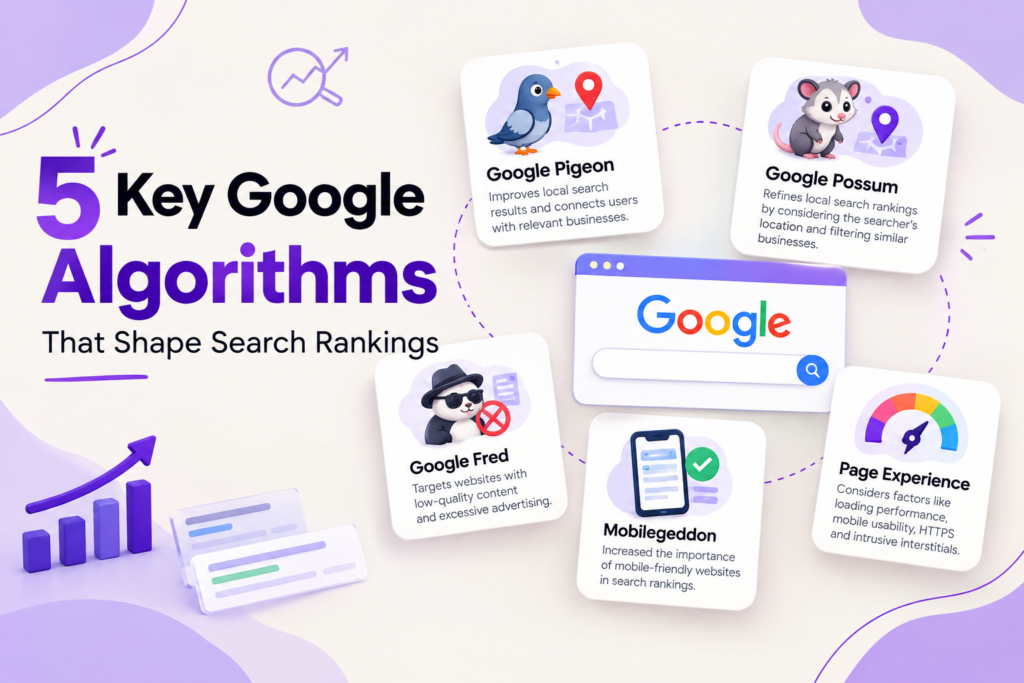
If you’ve ever wondered why your website’s rankings suddenly shifted overnight, chances are a Google algorithm update was behind it. Over the years, Google has rolled out hundreds of updates to its search algorithm, but a handful of them fundamentally changed how businesses approach SEO, local search, content quality, and mobile usability.
In this guide, we’ll break down five of the most talked-about Google updates — Pigeon, Possum, Fred, Mobilegeddon, and the Page Experience update — and explain what each one means, why it mattered, and how you can make sure your website stays on the right side of Google’s guidelines. Whether you’re a business owner, a marketer, or just curious about how search engines evolve, this article will give you a clear, jargon-free understanding of these landmark changes.
What Is Google Pigeon?
Google Pigeon was a major algorithm update rolled out in July 2014, aimed at improving local search results. Before Pigeon, local search rankings often felt disconnected from Google’s core ranking signals, which sometimes led to results that didn’t accurately reflect a business’s true relevance, distance, or prominence.
Pigeon tied local search more closely to traditional web ranking factors like backlinks, content quality, and on-page SEO. In simple terms, it made “local SEO” and “regular SEO” work more like a single, unified system rather than two separate processes.
Key impact of Pigeon:
Local pack and map results became more tightly linked to organic ranking signals
Directory sites (like Yelp) often saw ranking boosts
Business location, distance from the searcher, and citation consistency became more important
Businesses with weak local citations or inconsistent NAP (Name, Address, Phone) data often dropped in rankings
What Is Google Possum?
Released in September 2016, Google Possum built on Pigeon’s foundation and further refined how local search results are filtered and displayed. Possum is best known for diversifying local search results based on the searcher’s physical location — even small differences in where someone was searching from could produce noticeably different results.
Possum also addressed an issue where businesses sharing an address, or with similar names to competitors, could get filtered out of local results to avoid redundancy.
Key impact of Possum:
Search results became more sensitive to the physical location of the person searching
Businesses located just outside a city’s boundaries had a better chance of ranking for searches related to that city
Filtering was introduced to prevent multiple listings from similar-looking businesses at the same address
Local SEO became more nuanced, requiring closer attention to proximity and listing accuracy
What Is Google Fred?
Google Fred, rolled out in March 2017, was a somewhat mysterious update that Google didn’t officially confirm details about right away. Webmasters nicknamed it “Fred” after a joke by Google’s Gary Illyes, and the name stuck.
Fred primarily targeted websites that prioritized aggressive monetization over user value — think sites overloaded with ads, thin or low-quality content designed mainly to generate ad revenue, or content that didn’t align with Google’s Webmaster Guidelines.
Key impact of Fred:
Websites with excessive advertising and poor user experience saw significant traffic drops
Content that offered little genuine value to readers was penalized
The update reinforced Google’s ongoing message: content should serve the user first, not just serve ad revenue
It served as a wake-up call for aggressive affiliate and ad-heavy websites to improve content quality
What Is Mobilegeddon?
Mobilegeddon is the nickname given to the algorithm update Google launched on April 21, 2015, which made mobile-friendliness a direct ranking factor for mobile search results. At the time, the shift toward mobile browsing was accelerating rapidly, and Google wanted to ensure users got a good experience on sites viewed from smartphones and tablets.
The update specifically affected mobile search rankings (not desktop), rewarding sites that were responsive or had mobile-optimized versions, and penalizing those that weren’t easy to use on smaller screens.
Key impact of Mobilegeddon:
Non-mobile-friendly websites saw ranking drops in mobile search results
It accelerated widespread adoption of responsive web design
Businesses were pushed to prioritize page load speed, tap-friendly buttons, and readable text on mobile devices
It marked one of the earliest major signals that Google was shifting toward a “mobile-first” web
What Is the Page Experience Update?
The Page Experience update, introduced by Google starting in 2020 and rolled out through 2021, expanded on the idea behind Mobilegeddon by evaluating the overall experience a user has on a webpage — not just whether it’s mobile-friendly, but how it feels to use.
This update introduced Core Web Vitals as a set of measurable signals, alongside existing factors like mobile-friendliness, HTTPS security, and the absence of intrusive interstitials (like pop-ups that block content).
Core Web Vitals include:
Largest Contentful Paint (LCP): The speed at which a page’s primary content loads.
First Input Delay (FID) (later replaced by Interaction to Next Paint, INP): How quickly a page responds to user interaction
Cumulative Layout Shift (CLS): How visually stable a page is while loading (i.e., does content jump around unexpectedly?)
Key impact of the Page Experience update:
Site speed and visual stability became measurable ranking considerations
Secure browsing (HTTPS) and mobile usability continued to matter
Intrusive pop-ups and interstitials that hurt usability were discouraged
Overall, it signaled that Google now evaluates a website holistically — combining content quality with technical performance and user experienceFrequently Asked Questions (FAQ)
- Are Pigeon, Possum, Fred, Mobilegeddon, and the Page Experience update still relevant today? Yes. While these were specific rollouts at specific points in time, the principles behind them are baked into Google’s current algorithm. Local relevance, content quality, mobile usability, and page experience are still core ranking factors today.
- Do I need to do anything special to “recover” from these updates? Not from the updates themselves, since they happened in the past. However, if your site still has issues these updates targeted — like poor mobile usability, thin content, inconsistent local listings, or slow page speed — addressing those issues will still improve your rankings today.
- Which update had the biggest overall impact on SEO? It’s hard to name just one, but many SEO professionals consider Mobilegeddon and the Page Experience update especially significant because they permanently shifted the industry toward mobile-first, user-experience-focused design.
- How can I check if my site follows current best practices related to these updates? Use tools like Google Search Console, Google’s PageSpeed Insights (for Core Web Vitals), Google Business Profile (for local consistency), and a mobile-friendliness test to check where your site stands.
- Does Google still release major algorithm updates like these? Yes. Google regularly rolls out both broad “core updates” and more targeted updates. Staying informed through official Google Search Central announcements and reputable SEO news sources is the best way to keep up.
Conclusion
Google’s algorithm has come a long way, and updates like Pigeon, Possum, Fred, Mobilegeddon, and the Page Experience update each represent a shift toward a more relevant, trustworthy, and user-friendly search experience. From tightening local search accuracy to penalizing ad-heavy low-value content, and from mandating mobile-friendliness to measuring real-world page performance through Core Web Vitals, these updates tell a clear story: Google rewards websites that genuinely serve their users well.
The lesson for companies and website owners is straightforward. Focus on accurate local information, high-quality and valuable content, fast and stable mobile-friendly pages, and a smooth overall user experience. Do that consistently, and you’ll be well-positioned not just for past updates, but for whatever Google rolls out next.
Want to learn more about SEO? Check out our latest digital marketing blogs and strategies.